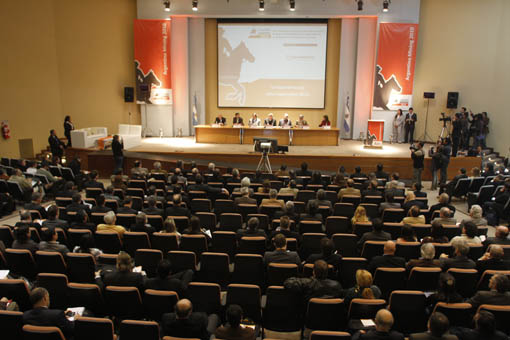
 SAN JUAN, ARGENTINA. SEPTEMBER 1st, 2010. The most important mining convention in Argentina initiated today, in San Juan, its second day of conferences and exhibition of mining companies and satellite sectors. Organized by Argentina Mining, the tradeshow gathered more than 400 companies of which 100 are mining companies. Over 550 participants are attending the conferences and mining-related companies exhibit in 110 booths. The convention ends tomorrow with an estimated attendance of more than 3,000 visitors during the three days.
Lectures on the second day of conferences centered around base and energy metals and industrial minerals. There was also a special section in the convention dedicated to the analysis of mining exploration in Argentina which offered a detailed observation of each producing province. Rojas & Asociados’ President, Nivaldo Rojas, offered a conference on the Argentinean copper and its essential role in mining development, and he forecasted that, “if the country exploits its resources, it can generate U$S 330,000 million . Also, if half of the copper ore deposits discovered in Argentina operate during the following 5 to 10 years, the country may become a serious competitor of major players in the field (except for Chile) as Peru, USA, Russia, Australia, and China.”
Bearing in mind that copper resources in Argentina are highly important and that there exist major ore deposits in the country, Rojas wonders why Argentina doesn’t produce more. “The answer lies in the high tax burdens, the highly expensive investments, the small number of Argentinean companies involved in high-risk projects, and the need to receive social acceptance. We must not forget other commodities with great opportunities in Argentina; however, copper is an extraordinary opportunity which has not been given the importance it deserves in our country. ”
Next, consultant Raúl Cabanay analyzed lime’s current situation in Argentina and stated that, “lime is a highly versatile chemical substance widely used around the world. It takes part, directly or indirectly, in the vast majority of man-made objects and it’s one of the six primary pillars on which the industry in general is supported. In industrialized countries, lime consumption per capita is estimated in 80 kilos per year and worldwide production is estimated in 300 million tones per year.”
As regards lime production, Cabanay said, “lime production represents 250 million dollars approximately and generates exports for 25 million dollars. Lime industry directly employs over 2,200 people and, indirectly, it requires 3, 5 and 4 people in each direct employment. The opportunities arising in the sector go hand in hand with the positive perspectives of the demanding sector, such as the development of future national mining projects that will require high-quality lime, the sharp increase in lime exports to Chile, the demand of the national steel industry and, of course, the construction industry.”
Cabanay also maintained that, “there will be a greater concentration in high-quality lime production. It’s necessary that national producers have access to credits, to foster the development of alternative fuels, to make possible the use of road trains, since lime is a very low-cost input product and transport greatly affects the final cost and, last, an effective aid to small producers granted by public and private organizations.” The Argentina Mining convention continued with José de Castro’s lecture, Orocobre, who focused on the development of Olaroz salar project where lithium production, a resource mainly used in batteries, is carried out in collaboration with Toyota Tsusho.
“The project is focused on a potential production of 15,000 tones per year of lithium carbonate, in a framework where annual world consumption is 110,000 tones of lithium, registering a steady increase due to consumption of lithium batteries. The key to succeed in this business lies in hybrid and electric automobiles’ growth and development,” explained de Castro who also commented that, “Toyota sold 2,500 hybrid vehicles and expects to produce 5,000 more. For that reason, the development of entirely electric vehicles is a safe bet once the industry may solve batteries’ autonomy and speed charging problems.”
Mining in Argentina was dedicated a detailed analysis per province. In this case, the conference opened with the words of Julio Ríos Gómez, GEMERA, who explained that, “the mining activity in Argentina which represented the 1.5% of the gross domestic product in 1998 increased to 4.5% in 2009. With the opening of the three ore deposits that will soon come to light (Casposo, Pascua Lama y Potasio Río Colorado), incomes will rise to 6%.”
Ríos Gómez raised hopes when he said that, “in the following 5 years Argentina expects an investment of 1,500 million dollars, though we are far behind other countries, such as Peru, which will receive between 6 and 7 thousand million dollars in investments in the same period.” He acknowledged that an important obstacle in mining development is that, “Argentina is divided between mining provinces that promote the activity and non-mining provinces that put obstacles with their legislation.”
Gioja gathered with the president of SONAMI (Chile) Within the framework of the mining convention Argentina Mining 2010, the governor of the province of San Juan, José Luis Gioja, hold a meeting with the president of The National Mining Association of Chile (SONAMI), Alberto Salas. Both authorities expressed their interest in working together and exchanging information and experiences related to the mining development in Chile and its favorable economic-social impact in the country.
During the meeting, which took place in the Presidential Palace of the Province of San Juan, the leader of the Chilean mining labor union underlined the mining contribution to the growth and improvement of quality-of-life indicators in the country and, particularly, in mining regions. That is how these regions register the lowest poverty rates; likewise, workers in large-scale mining show the highest schooling rates and the best salaries.
The governor of San Juan, José Luis Gioja showed his interest in learning at depth and transmitting the Chilean mining experience in Argentina, for which purpose SONAMI would be an ideal partner. The Secretary of Mining of San Juan, Felipe Saavedra, also participated in the meeting carried out this morning.


https://www.argentinamining.com/en/en-el-segundo-dia-continuo-el-debate-en-argentina-mining-2010